The GenAI Divide: Why 95% of AI Investments Are Failing - and What the Other 5% Know
MIT's research puts a number on what we've been seeing in the field: only 5% of enterprise AI pilots deliver measurable returns. The divide isn't about technology - it's about strategy, focus, and knowing where the real ROI hides.


I've been seeing a lot of chatter about GenAI, but there's a disconnect between the hype and what's actually happening on the ground.
It seems we're splitting into two camps: those who are just testing the waters, and the tiny few who are actually making it work for their bottom line.
MIT recently put a number on this. Their 2025 report, The GenAI Divide, examined 300 public AI deployments, surveyed hundreds of employees and leaders, and arrived at a finding that should give every executive pause: only 5% of enterprise AI pilots are delivering measurable financial returns. The other 95% have produced little to no impact on profit and loss.
That's not a technology failure. That's a strategy failure happening at enormous scale.
Despite $35-40 billion in collective enterprise AI investment, the vast majority of organizations are seeing zero measurable return. The divide isn't between companies that have AI and companies that don't - it's between companies that deploy AI strategically and companies that deploy it hopefully.
The Shape of the Divide
The MIT research reveals a predictable funnel - and a brutal drop-off at every stage.
Sixty percent of organizations evaluated enterprise-grade AI systems. Only 20% got to pilot. Only 5% reached production. The rest are stuck - not because the technology failed, but because the implementation approach wasn't designed to succeed.
The researchers were clear about what drives this divide: it's not model quality, regulatory barriers, or infrastructure limitations. It's implementation approach. How you deploy AI matters far more than which AI you deploy.
The Pilot Trap
Large enterprises run the most pilots but convert the fewest. Mid-market organizations move from pilot to full implementation in roughly 90 days. Large enterprises? Nine months or longer. Size isn't an advantage here - it's often an obstacle.
Where the Money Goes (vs. Where It Should)
Here's one of the most striking findings from the MIT research: more than half of all generative AI budgets are flowing into sales and marketing tools. That's where the flashy demos live. That's where executives see the "wow" factor.
But the highest ROI? It's in back-office automation. Administrative functions. Customer service. Operations. HR. The work that nobody puts on a slide deck but that consumes enormous amounts of human time.
Successful implementations in these areas are generating $2-10 million annually in cost reductions - primarily by eliminating business process outsourcing, cutting external agency costs, and streamlining operations that were previously too complex to automate.
| Where AI Budgets Go | Where AI ROI Actually Lives |
|---|---|
| Sales & marketing (50%+ of spend) | Back-office automation |
| Flashy customer-facing demos | Customer service operations |
| Internal chatbot experiments | Administrative process elimination |
| Content generation tools | BPO cost reduction |
It's a strange situation. Companies are pouring money into the visible, impressive areas while the quiet wins - the massive efficiency gains in repetitive operations - are being overlooked.
The 5% succeeding with AI share a common trait: they pick one pain point, execute well, and partner smartly. They don't try to transform everything at once. They find the process with the clearest ROI and go deep.
The Shadow AI Economy
While official AI programs stall in committee meetings and procurement cycles, something interesting is happening at the ground level. MIT's research documented the rise of what they call the "shadow AI economy."
The numbers are striking: only 40% of companies say they've purchased an official LLM subscription. But workers from over 90% of surveyed organizations report regular use of personal AI tools for work tasks. That's a massive gap between what companies are sanctioning and what their people are actually doing.
Your team members are probably already getting ahead using everyday tools like ChatGPT to solve their own problems. They're drafting documents, summarizing meetings, analyzing data, writing code - all with personal subscriptions that their IT department doesn't know about.
The Shadow AI Paradox
Personal AI tools succeed where enterprise deployments fail because individuals can experiment freely, iterate quickly, and measure value in terms of their own productivity. The challenge is that these personal wins don't scale into organizational transformation without structure, governance, and integration.
This shadow usage demonstrates something important: the barrier to AI adoption isn't willingness or capability. People want to use AI. They can figure out how to use AI. The barrier is that organizations haven't created the right conditions for that individual enthusiasm to translate into enterprise-wide impact.
Why Top-Down AI Projects Fail
MIT's findings align with what we see across every industry: official, top-down AI projects get tangled up in process and stall before they ever make a real impact.
The pattern is consistent. An executive sees a compelling demo. Budget gets allocated. A cross-functional team gets assembled. Months of requirements gathering follow. An enterprise-grade tool gets procured. A pilot launches. And then... nothing. The pilot produces interesting results but never reaches production because:
The workflow integration wasn't designed from the start. Most AI systems are evaluated based on their standalone capabilities, not on how they connect to the tools and processes people already use. A brilliant AI that requires five extra steps in someone's day will be abandoned within weeks.
The success criteria were vague. "Improve productivity" isn't measurable. "Reduce invoice processing time from 15 minutes to 3 minutes" is. Without clear, quantifiable targets tied to business outcomes, pilots drift into permanent experimentation.
The wrong use case was chosen. Companies tend to pick use cases based on executive excitement rather than business impact analysis. The most impressive demo doesn't correlate with the highest ROI. The highest ROI usually lives in the most boring processes.
The core barrier to scaling is not infrastructure, regulation, or talent. It is learning.
What the 5% Do Differently
The organizations that are actually making AI work for their bottom line share a set of distinctive practices. None of them are particularly glamorous. All of them are effective.
They Focus Ruthlessly
The successful companies don't try to "implement AI across the enterprise." They identify a single, high-value process and deploy AI to transform it completely. MIT's lead researcher noted that successful organizations tend to pick one pain point, execute well, and partner with companies whose tools fit their specific workflow.
This focus produces results fast. Some organizations in the 5% club went from zero to multi-million-dollar deployments within months - because they weren't trying to boil the ocean.
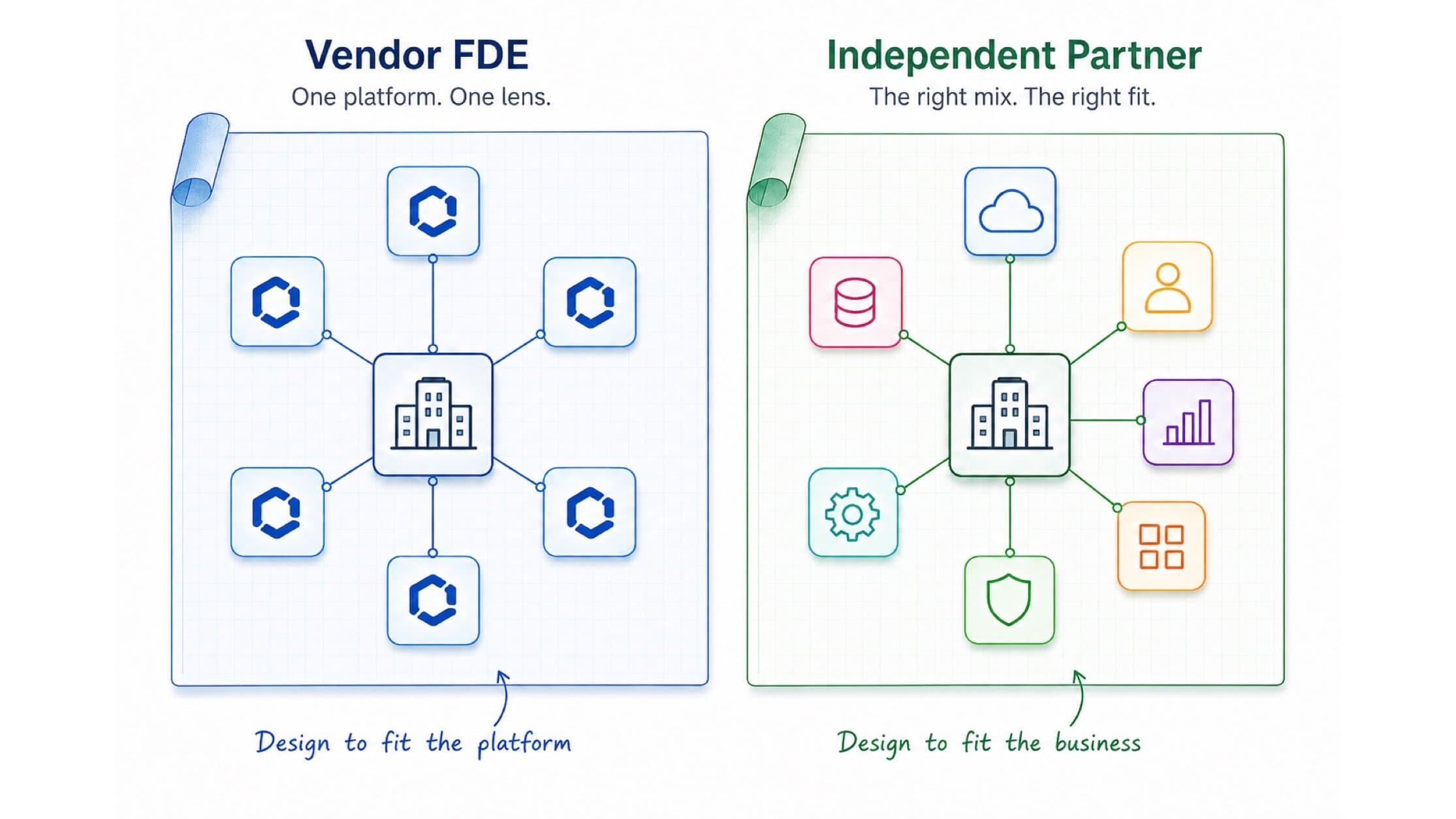
They Buy More Than They Build
MIT found that tools built by external vendors and specialized partners succeed at roughly twice the rate of internally developed solutions. External partnerships achieve around a 66% deployment success rate, compared to roughly 33% for internal builds.
This makes sense. Specialized vendors have already solved the integration challenges, refined the workflows, and learned from dozens of deployments. Building internally means learning all those lessons from scratch - at great expense and greater delay.
They Measure Business Outcomes, Not AI Metrics
The 5% evaluate AI by revenue impact, cost reduction, and operational efficiency - not by model accuracy, token throughput, or number of prompts processed. They tie every AI initiative to a number that their CFO cares about.
They Integrate, Don't Bolt On
Successful deployments embed AI into existing workflows rather than creating new ones. When AI surfaces inside the tools people already use - inside the CRM, the ERP, the communication platform - adoption happens naturally. When it requires a new login and a new workflow, it dies.
This Isn't a Tech Problem
It all points to one thing: this isn't a tech problem. It's a strategy and people problem.
Having the tool is one thing. Knowing how to weave it into the fabric of your business is something else entirely. The AI models are extraordinary - they're the most capable technology most of us have seen in our careers. But capability without direction produces noise, not results.
The organizations on the right side of the divide share a common approach:
They start with the process, not the technology. Before selecting any tool, they map the workflow they want to transform. They understand exactly where time is wasted, where errors occur, and where automation would produce the clearest return.
They empower line managers, not just central AI labs. MIT found that pushing AI decision-making to the people closest to the work produces better outcomes than centralized, top-down mandates. The people who do the work every day understand where the pain points are.
They accept that AI is a people challenge. Technology adoption is behavior change. Behavior change requires trust, training, and visible proof that the new approach is better than the old one. The 5% invest in all three.
The Starting Point
If your organization is stuck trying to turn AI hype into actual returns, start with this question: "What is the single most time-consuming, rule-based process in our business that we could automate with clear, measurable criteria for success?" That's your first AI project. Not the most impressive one - the most impactful one.
Bridging the Divide
The GenAI Divide isn't permanent. It's a function of approach, not capability. The technology is available to everyone. The data on what works is now public. The playbook is clear:
Pick one process. Quantify the current cost. Choose a partner with domain expertise. Deploy narrowly. Measure relentlessly. Expand only when the first use case is proven.
The 5% didn't get lucky. They got focused. And that's available to any organization willing to trade hype for discipline.
The divide between AI success and AI failure isn't about budget, technology, or talent. It's about whether you approach AI as an experiment or as an operation. The 95% are experimenting. The 5% are operating. The difference is millions in measurable value.
If your organization is on the wrong side of the divide - or if you're not sure which side you're on - let's talk. We help leaders build practical strategies that turn AI investment into measurable business outcomes.
Find Kipanga useful? Add us as a preferred source and Google will surface more of our work in your results.


25+ years of experience in web development and technology leadership. AWS-certified professional who has led major digital projects for brands like A2 Milk, Toll, and Uniting. Advocates a pragmatic, milestone-driven approach to technology.
View profile
Ready to scale your operations?
Let's discuss how Kipanga can architect the systems that power your next phase of growth.
Start the Discovery