You Can Make Vibe Coding Reliable & Secure
AI-assisted coding delivers 300% faster feature velocity - but nearly half of AI-generated code introduces vulnerabilities. The Inverted TDD Cycle fixes this by flipping test-driven development on its head.

- 01You Can Make Vibe Coding Reliable & Securereading now
- 02
- 03
There are real advantages to AI-assisted coding - or "vibe coding," as it's become known. Feature velocity increases by 300%. Development costs drop. Developers focus on intent and architectural orchestration rather than grinding out syntax.
But there's a downside. Approximately 45% of AI-generated code introduces security vulnerabilities, and logic errors are nearly 1.75x more likely than in human-authored code.
At Kipanga we found a solution: it is possible to reliably use AI in the coding cycle by evolving quality control through what we call the Inverted TDD Cycle.
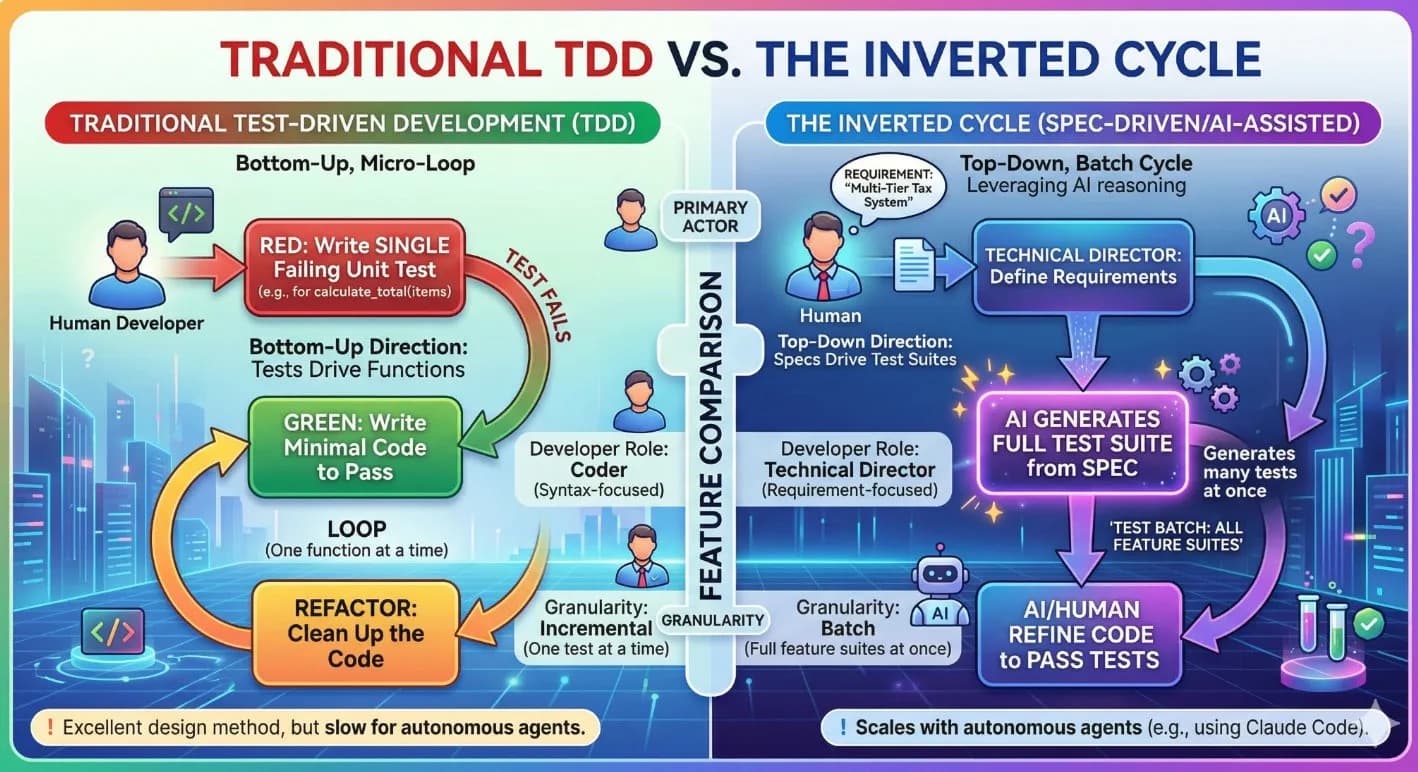
Traditional TDD vs. The Inverted Cycle
Traditional Test-Driven Development follows the classic "Red, Green, Refactor" mantra. It's a bottom-up, micro-loop process: the human writes a single failing unit test, writes the code to pass it, then cleans it up. It's an excellent way to design software - but it's too slow for the era of autonomous agents.
The Inverted TDD Cycle (also known as Spec-Driven Development) flips this methodology on its head to leverage AI reasoning at scale.
| Feature | Traditional TDD | Inverted (AI-Assisted) TDD |
|---|---|---|
| Primary Actor | Human developer writes every test | AI generates the test suite from a spec |
| Workflow Direction | Bottom-up: Tests drive functions | Top-down: Specs drive test suites |
| Developer Role | Coder (syntax-focused) | Technical Director (requirement-focused) |
| Granularity | Incremental: One test at a time | Batch: Full feature suites at once |
The Role Shift
The developer stops being a coder and becomes a technical director. Instead of writing syntax, you define requirements. Instead of reviewing code line-by-line, you validate that the test suite captures intent.
The Spec-Test-Code Workflow
In our enterprise vibe coding setup, the workflow moves through four distinct phases:
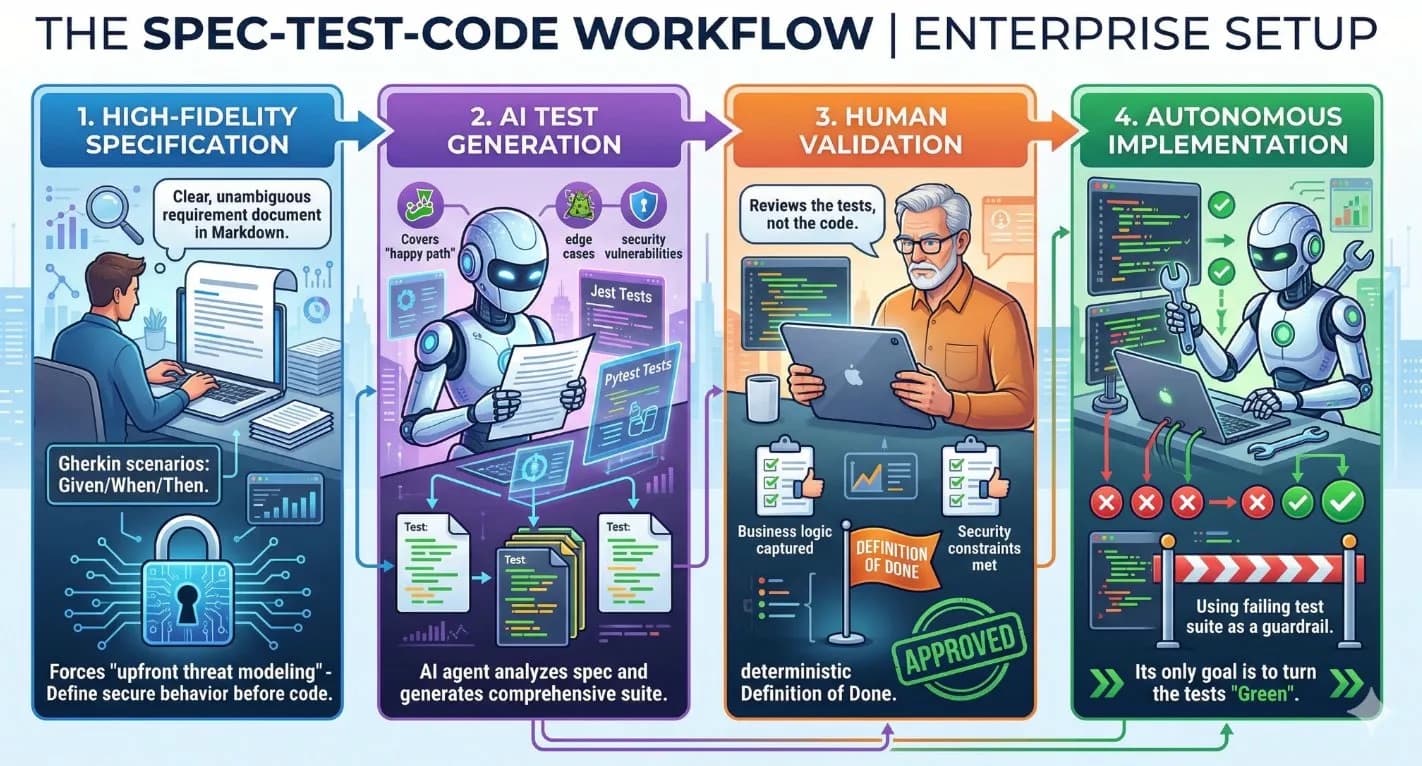
1. High-Fidelity Specification. The developer writes a clear, unambiguous requirement document in Markdown, often using Gherkin (Given/When/Then) scenarios. This forces "upfront threat modeling" - you must define secure behavior before the first line of code is written.
2. AI Test Generation. The AI agent analyzes the spec and generates a comprehensive suite of Jest or Pytest tests covering the "happy path," edge cases, and security vulnerabilities.
3. Human Validation. This is the critical "Technical Director" moment. A senior engineer reviews the tests, not the code. If the tests correctly capture the business logic and security constraints, they become the deterministic "Definition of Done."
4. Autonomous Implementation. Using the failing test suite as a guardrail, the agent implements the code. Its only goal is to turn the tests "Green."
Why Your "Vibe Coding" Setup Needs This
If your team is simply asking an AI to "write a login component," they are gambling. Without the Inverted TDD cycle (the workflow we roll out for engineering teams through our AI Augmented Academy) you face three systemic risks:
API Hallucinations and Bloat. AI assistants have a tendency to over-engineer solutions or call non-existent libraries. Tests enforce a minimalist philosophy: the AI writes only what is needed to make the tests pass.
The "Phantom Bug" Phenomenon. AI-generated code often looks correct and even passes basic syntax checks, but contains subtle logic errors. By defining correctness in a test suite before implementation, you expose these flaws immediately.
Invisible Debt. AI-generated debt compounds faster because the assumptions the model makes are often invisible to standard code reviews. The Inverted cycle surfaces these assumptions explicitly during the test review phase.
Without the Inverted TDD cycle, AI-generated code looks right, passes linting, and ships fast - then fails silently in production. Tests written before code are the only deterministic safeguard.
Why Gherkin Markdown Is Your Reliability Engine
When requirements are written in plain paragraphs, they are inherently open to interpretation. A developer might interpret a "secure login" requirement as simple password checking, while a security auditor expects Argon2 hashing, rate limiting, and specific JWT rotation logic.
Gherkin syntax - the structured Given/When/Then formula - removes this ambiguity by transforming abstract business needs into binary pass/fail conditions before a single line of code is written.
Why Gherkin Works for AI Agents
Gherkin scenarios are machine-readable and act as an immutable contract. They ensure the AI's "machine-driven intent" remains aligned with your project's "secure-by-design" requirements - eliminating the architectural drift that plagues unguided AI code.
At Kipanga, we use Gherkin within Markdown files to provide a "logical blueprint" for our AI agents. This delivers three critical safeguards for professional applications:
Upfront Threat Modeling. Gherkin forces you to define exactly what secure behavior looks like - input validation rules, session timeout protocols, token expiration handling - at the start. If you haven't specified a negative scenario in your Gherkin spec, such as what should happen when an expired token is used, the AI is statistically likely to omit the necessary security guard clause.
Neutralizing "Architectural Drift." AI agents can make subtle design changes that break security assumptions without violating code syntax. Because Gherkin scenarios act as an immutable contract, they keep the implementation aligned with your secure-by-design requirements throughout the build.
Declarative Precision. Unlike manual test scripts that focus on granular clicks, professional Gherkin focuses on intent and state (e.g., "When the Admin removes the file" instead of "When I click button #id_42"). This declarative style helps the AI generate more modular, maintainable implementations that are significantly less likely to contain logic errors.
By shifting the cognitive load to the specification phase, "vibe coding" doesn't just produce fast code - it produces code that is secure, reliable, and audit-ready for enterprise standards.
Reliable Vibe Coding
By adopting the Inverted TDD workflow and changing the way we write specifications, we've achieved increased development velocity while maintaining high standards of reliability and security. Our developers focus on design and meeting stakeholder expectations rather than code semantics - and most importantly, they produce reliable, secure code.
Proving that you can have your cake and eat it at the same time.

Ready to make your AI-assisted development reliable and secure? Let's talk about implementing the Inverted TDD Cycle across your engineering team.
Find Kipanga useful? Add us as a preferred source and Google will surface more of our work in your results.


25+ years in technology innovation. Founder and former CTO of MyFleet, a leading telematics platform. Technical Lead for GenAI at University of Newcastle. Expert in AI, Machine Learning, IoT, and Agile development.
View profile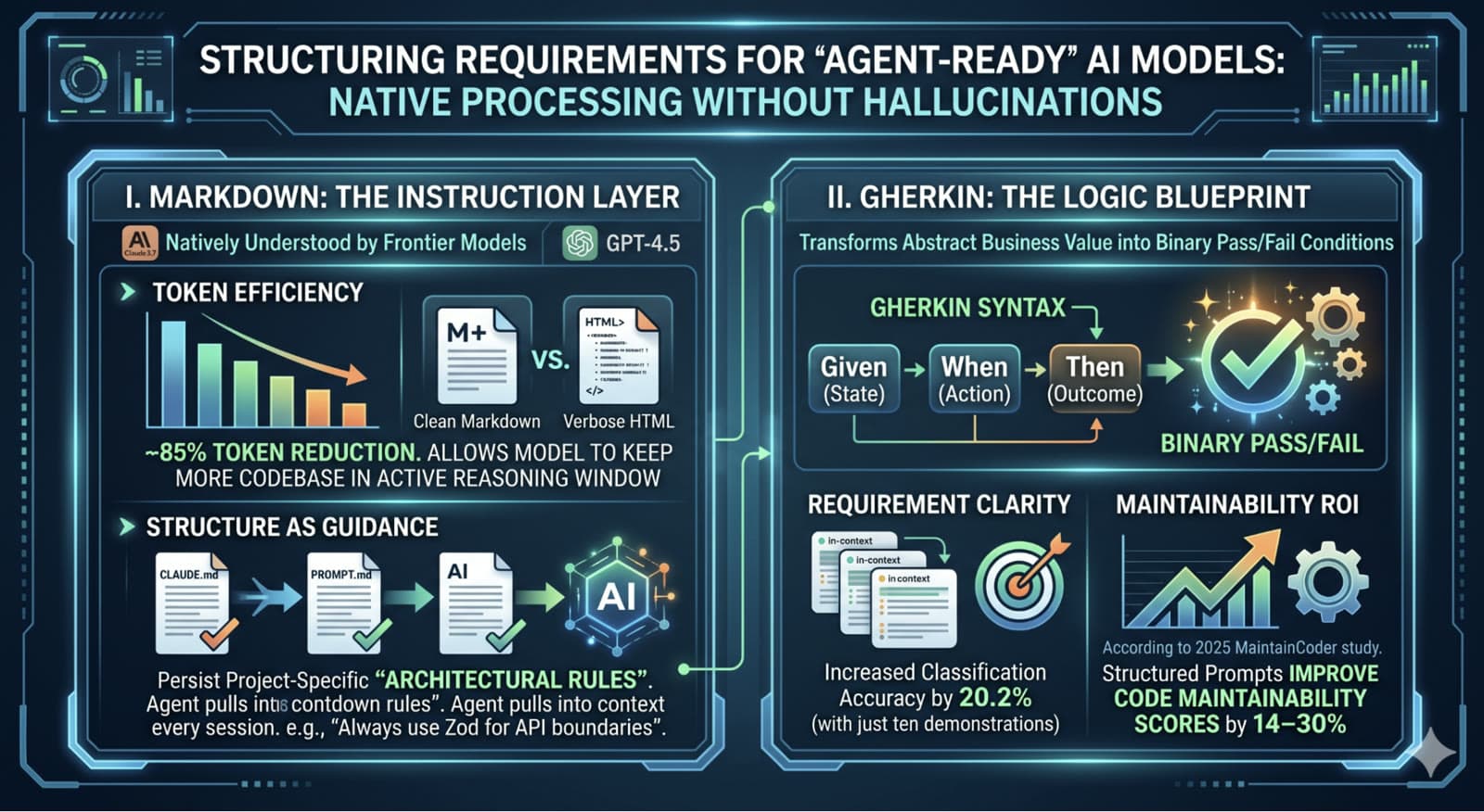
Ready to scale your operations?
Let's discuss how Kipanga can architect the systems that power your next phase of growth.
Start the Discovery