Forward Deployed Engineers: look past the job title
OpenAI's Deployment Company has put the Forward Deployed Engineer back in the spotlight. The role matters, but a vendor FDE and an independent partner solve different problems. Here's how to tell which one you need first.

OpenAI's launch of the OpenAI Deployment Company has brought new attention to a role that has been around for years: the Forward Deployed Engineer, or FDE.
The term is strongly associated with Palantir, where engineers have long worked close to customers to solve complex operational problems. OpenAI is now applying a similar model to enterprise AI deployment.
That says something useful about where AI is heading.
The next stage is not just about who has the best model. It is about who can make AI useful inside a real business.
And that is the part many organizations are still wrestling with.
Better AI models do not automatically create better businesses. The value comes from deployment.
What is a Forward Deployed Engineer?
A Forward Deployed Engineer is a technical person who works close to the customer's operating environment.
They are not waiting for a tidy requirements document. They are usually closer to the real work: the people, systems, processes, data, exceptions, politics, constraints, and workarounds that shape daily operations.
In plain English, a good FDE helps answer questions like:
- Where can this technology actually help?
- What needs to change in the workflow?
- Which systems need to connect?
- What needs to be built, configured, automated, or retired?
- How do we get people to trust and use the result?
That is why the role is getting more attention in AI.
Most organizations have already tried the easy version: ChatGPT, copilots, internal prompts, maybe a proof of concept or two.
The harder question is what comes next.
How do you connect AI to the work that matters? How do you make it safe enough, useful enough, and reliable enough that people use it every week?
That is deployment work.
Why OpenAI's move matters
OpenAI described its Deployment Company as a way to embed engineers into organizations and help them redesign workflows around AI.
That is a clear signal. The biggest AI companies know that access to a model is not enough. If businesses cannot turn AI into working systems, the value stays theoretical.
For business leaders, this is a useful correction. It moves the conversation away from "which AI tool should we buy?" toward a sharper one.
Where should AI change the way we work?
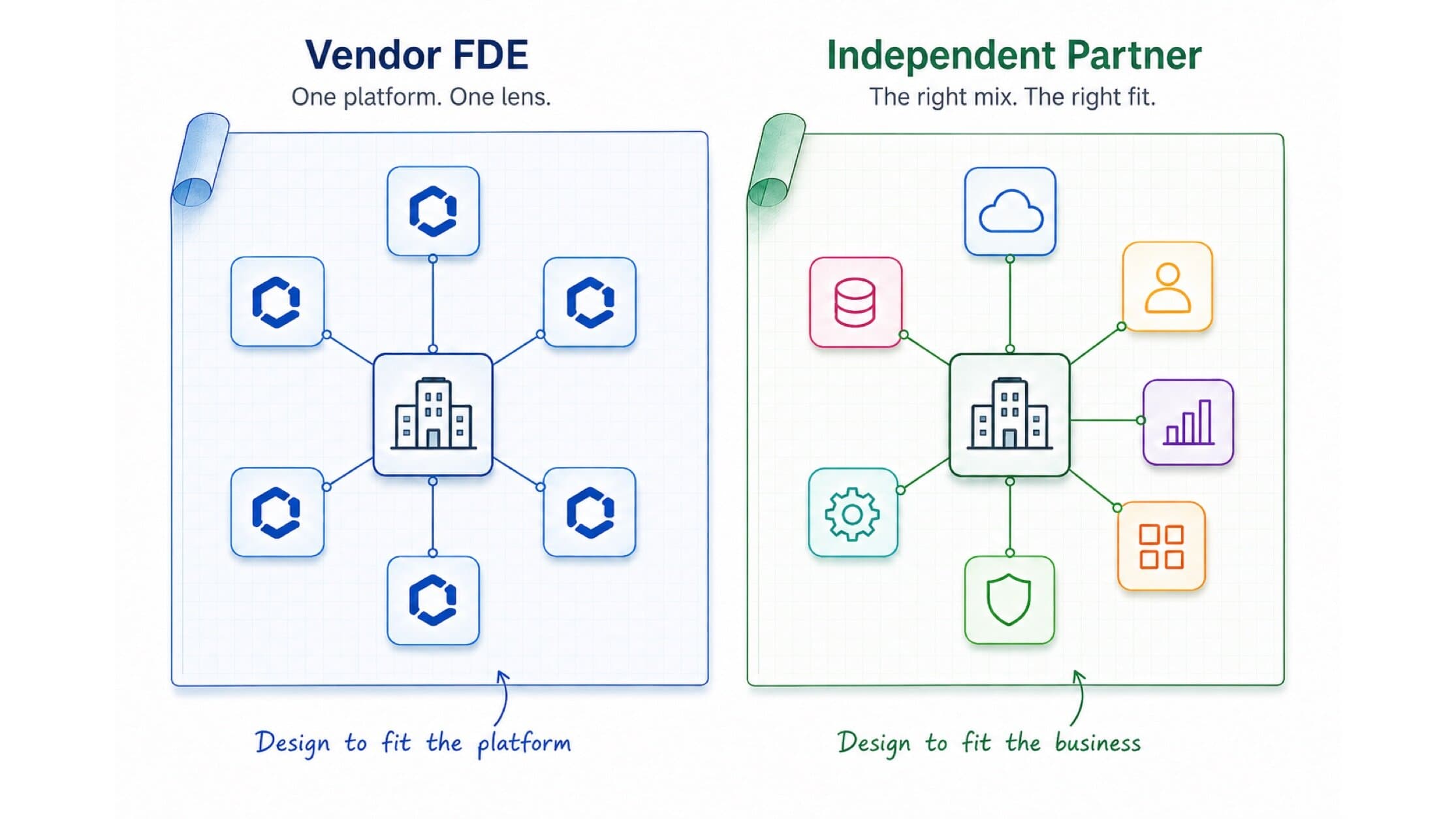
The vendor FDE model can work, but it has a lens
A vendor FDE can be valuable.
If your organization has already chosen a platform, and that platform is clearly the right one, then having the vendor's experts help you deploy it can speed things up. They know the product. They know the roadmap. They know the patterns that have worked elsewhere.
But every vendor sees the world through its own platform.
That is not a criticism. It is just how incentives work.
A vendor's forward deployed team is there to help you succeed with that vendor's technology. If you are working with OpenAI, the answer will naturally lean toward OpenAI. If you are working with another platform, the same thing applies.
Sometimes that is fine.
But many businesses are not ready to make that call. They still need to work out whether the problem is best solved with generative AI, workflow automation, better data, a custom application, CRM improvements, cloud integration, process redesign, or a mix of these.
That decision should come before the platform commitment.
Why Kipanga can be the better first move
Kipanga takes the useful part of the FDE idea, being close to the business problem, but without being tied to one vendor's ecosystem.
That changes the conversation.
We are not starting with "how do we deploy this AI platform?"
We are starting with:
- What are you trying to improve?
- Where is the friction?
- What work is repetitive, slow, risky, or hard to scale?
- What data and systems are already in place?
- What would make a measurable difference?
From there, the answer might involve OpenAI. It might involve another AI model. It might involve business automation and AI, custom software, cloud infrastructure, integration work, or one of Kipanga's ready-to-deploy AI products.
The point is to choose the right approach, not to force the business into a vendor-shaped solution.
A vendor FDE can help you move faster inside a platform. An independent partner can help you decide whether that platform is the right move in the first place.
AI deployment is rarely just AI work
This is the bit that gets missed.
A useful AI deployment often touches sales, marketing, operations, customer service, data quality, reporting, compliance, staff training, and system integration.
You might have a clever model and still fail because the data is poor, the workflow is unclear, or the team does not trust the output. You might automate the wrong step. You might save time in one team and create risk in another.
Good deployment work is practical and sometimes unglamorous. It asks boring questions early so the expensive mistakes do not happen later.
That is why Kipanga's scope-to-scale delivery method matters. The work needs discovery, delivery, deployment, and maintenance. Not just a demo.
When a vendor FDE makes sense
A vendor FDE may be the right choice if you have already committed to that vendor, the use case clearly fits their platform, and your team has the internal capability to manage the broader change.
An independent partner is usually a better starting point if you are still deciding where AI should fit, several tools or platforms could be involved, or the problem cuts across teams and systems.
Neither model is automatically better. They solve different problems.
The mistake is assuming a vendor-led deployment is the same thing as a business-led transformation.
The bigger lesson
The growing attention on Forward Deployed Engineers is a good sign. It means the AI market is maturing.
Businesses are starting to realise that demos are not enough. The value comes when AI is connected to real workflows, real data, real decisions, and real accountability.
A vendor FDE can help you move faster within a platform.
An independent partner can help you choose the right path before you commit to one.
For many organizations, that is the more important conversation.
Find Kipanga useful? Add us as a preferred source and Google will surface more of our work in your results.


25+ years of experience in web development and technology leadership. AWS-certified professional who has led major digital projects for brands like A2 Milk, Toll, and Uniting. Advocates a pragmatic, milestone-driven approach to technology.
View profile
Ready to scale your operations?
Let's discuss how Kipanga can architect the systems that power your next phase of growth.
Start the Discovery