AI Isn't Magic. It's Math That Punishes Sloppy Data.
85% of AI projects fail - and the primary culprit isn't the model. It's the data underneath. Here's why treating data like production code, with types, tests, and monitoring, is the single most important thing you can do for your AI initiative.

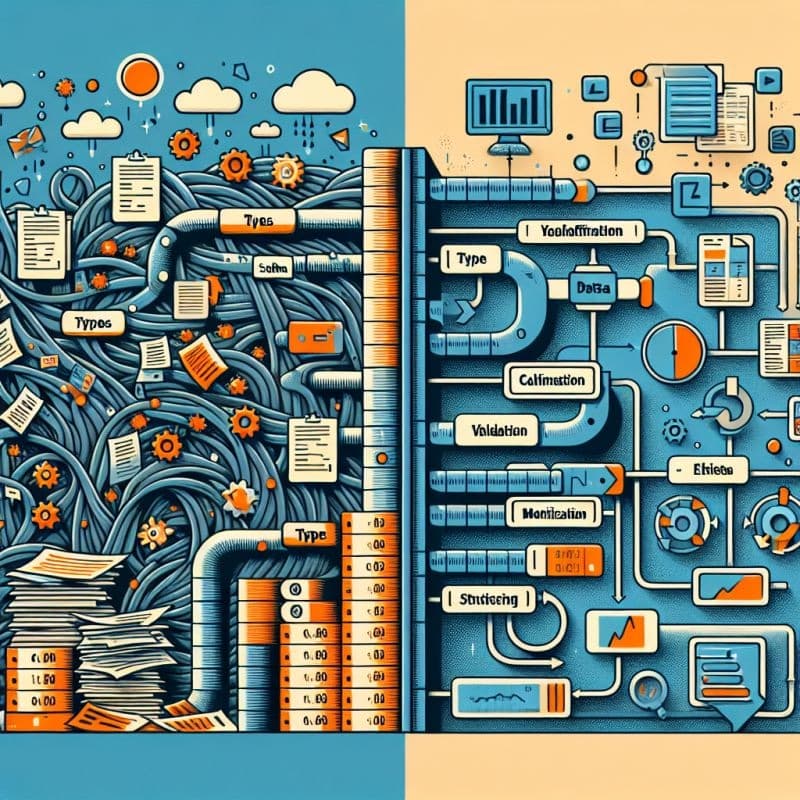
AI isn't magic. It's math that punishes sloppy data.
That sentence should be printed on a poster and hung in every boardroom where AI budgets are being discussed. Because the uncomfortable truth behind most AI failures isn't a flawed algorithm, an underpowered model, or a bad vendor. It's bad data.
Most AI wins or failures trace back to data, not models. Algorithms behave when inputs are consistent. Messy inputs create brittle results. This should be obvious, but given the billions being spent on AI tools while data foundations remain neglected, it's clearly not obvious enough.
Gartner predicts that through 2026, organizations will abandon 60% of AI projects that lack AI-ready data. The model isn't the bottleneck. The data is.
The Scale of the Problem
The numbers on data quality failures are staggering - and they've been staggering for years. What's changed is that AI has dramatically amplified the cost of getting data wrong.
IBM's 2025 CDO Study found that over a quarter of organizations estimate they lose more than $5 million annually to poor data quality, with 7% reporting losses exceeding $25 million. Meanwhile, 43% of chief operations officers identify data quality as their most significant data priority.
And here's the part that should worry every AI leader: a 2025 Qlik survey of 500 AI professionals found that 85% believe their leadership isn't adequately addressing data quality issues, even as 96% of those same professionals warn that neglecting data quality could lead to widespread crises.
The data problem isn't hidden. Everyone working on AI knows it's there. The disconnect is between the people building AI systems and the people funding them.
The Leadership Blind Spot
Qlik's survey revealed that 90% of data professionals at the director or manager level believe leadership isn't paying adequate attention to data quality, compared to 76% of executives. The people closest to the data see the problem most clearly. The people with the budget to fix it often don't.
Why Data Quality Matters More in the AI Era
Bad data has always been expensive. What makes it devastating in the AI context is amplification. A human analyst encountering a bad data point might notice something looks off. An AI system trained on bad data will learn the wrong patterns and apply them at scale, confidently and consistently.
Traditional software fails in predictable ways - you get an error message, a crash, an obviously wrong output. AI systems fail subtly. The output looks plausible. The recommendation seems reasonable. The prediction feels right. But it's built on a flawed foundation, and the failure might not become visible until it's caused real damage.
This is especially critical as organizations deploy AI agents - systems that don't just analyze data but take actions based on it. IBM's Institute for Business Value found that 49% of executives cited data inaccuracies and bias as a barrier to adopting agentic AI. When an AI system can approve transactions, send communications, or modify records autonomously, the margin for data error shrinks to near zero.
When AI investment scales, the cost of poor data quality scales with it. The margin for error narrows with every dollar spent on models that are only as reliable as the data feeding them.
The Six Controls That Actually Matter
You can't fix data quality with a one-time cleanup project. Data quality is an ongoing discipline - more like fitness than surgery. Here are the six controls that separate organizations with reliable AI from those burning money on brittle systems.
1. Enforce Strong Types and Strict Schemas at Ingest
Stop garbage before it flows downstream. Every data point entering your systems should pass through validation that checks type, format, range, and completeness. A phone number field that accepts free text is a data quality problem waiting to happen. A date field that allows multiple formats is a future parsing failure.
This is the cheapest point in the pipeline to catch errors. The 1-10-100 rule applies: it costs $1 to prevent a data error, $10 to correct it after it's been recorded, and $100 to correct it after it's been used in downstream processes.
| Prevention Point | Cost | Example |
|---|---|---|
| At ingest | $1 | Schema validation rejects malformed entry |
| After storage | $10 | Data team identifies and corrects bad record |
| After downstream use | $100+ | AI model retrained, decisions reversed, customers notified |
2. Validate and Profile Data Continuously
Data isn't static. It decays. Contact information changes, product catalogs evolve, market conditions shift. Research shows that B2B contact data degrades between 22% and 70% annually. What was accurate six months ago may be misleading today.
Continuous data profiling means monitoring your datasets for drift, anomalies, and degradation over time - not waiting for a quarterly audit to discover that your model has been training on stale information.
Data Drift Is Silent
Data teams spend up to 50% of their time on data quality remediation. Continuous profiling catches drift early, turning a reactive fire drill into a manageable, automated process.
3. Track Lineage and Provenance
When a model produces an unexpected output, the first question is always: "What changed in the data?" Without lineage tracking, answering that question requires manual investigation across multiple systems and teams.
Data lineage means knowing which source changed, when it changed, and why - for every data point that feeds your AI systems. This isn't just good hygiene. Under frameworks like the EU AI Act, organizations deploying AI in high-risk contexts need to demonstrate auditability. Lineage is the foundation of that auditability.
4. Version Data and Run Data CI
Software engineers wouldn't dream of deploying code without version control and continuous integration testing. Data deserves the same discipline.
Version your datasets. Run automated tests against them before they're used for model training or inference. Validate that schema changes don't break downstream consumers. Treat data changes with the same rigor as code changes - because in an AI system, data changes are effectively code changes. They alter the system's behavior.
5. Define Data Contracts and Assign Ownership
One of the most persistent sources of data quality failure is ambiguity about who owns what. When nobody is responsible for the accuracy of a dataset, nobody maintains it. When multiple teams produce overlapping data with different definitions, semantic conflicts are inevitable.
Data contracts formalize the agreement between data producers and data consumers: what fields are available, what their types and formats are, what freshness guarantees apply, and who to contact when something breaks. This reduces surprises in production and creates clear accountability.
The Semantic Debt Problem
In one system, "Account" is a client. In another, it's a ledger entry. One team's "Churn" means cancellation; another's means downgrade. These ambiguities don't matter much in manual processes. They're catastrophic in AI systems that need to reason across data sources.
6. Monitor Data Quality and Model Signals Together
Most organizations monitor data quality and model performance separately. The data engineering team watches for schema violations and null rates. The ML team watches for accuracy degradation. But the two monitoring streams rarely connect.
When model accuracy drops, the investigation starts from scratch: is it the model? Is it the data? Is it the feature pipeline? Is it the production environment?
Unified monitoring connects data quality signals to model behavior signals, making it immediately obvious when a data quality regression is the root cause of a model performance issue. This is the difference between a multi-day investigation and a five-minute diagnosis.
Treat Data Like Production Code
The throughline across all six controls is a single principle: treat data like production code.
Production code has types. Data should have strict schemas. Production code has tests. Data should have automated validation. Production code has version control. Data should have versioned snapshots and lineage. Production code has monitoring. Data should have continuous profiling and alerting. Production code has code review. Data changes should have review processes and contracts.
This discipline outperforms ad hoc prompt tinkering every time. You can spend weeks optimizing a prompt or fine-tuning a model, but if the underlying data is inconsistent, incomplete, or stale, the improvement will be marginal and fragile.
43% of chief operations officers identify data quality as their most significant data priority.
The organizations seeing real returns from AI aren't the ones with the most sophisticated models. They're the ones with the most disciplined data practices. They've invested in the boring, invisible infrastructure that makes AI reliable - and that infrastructure is what separates a promising demo from a production system that delivers consistent value.
Where to Start
If your organization is planning or expanding AI initiatives, here's a practical starting point for assessing your data readiness:
Audit your critical data sources. For each dataset that will feed an AI system, answer: Who owns it? When was it last validated? What percentage of records are complete and accurate? What's the update frequency?
Identify your semantic conflicts. Find the terms that mean different things in different systems. "Customer," "Account," "Active," "Revenue" - these are the words that cause AI systems to produce subtly wrong outputs at scale.
Implement one control at a time. You don't need all six controls on day one. Start with schema validation at ingest - it's the highest leverage, lowest effort improvement. Then add continuous profiling. Then lineage. Build the discipline incrementally, just like you'd build any other engineering practice.
Connect data quality to business outcomes. Every data quality metric should link to a business impact. Don't track null rates for their own sake. Track them because a 5% null rate in your customer address field means 5% of your shipping predictions are unreliable.
The AI model is the engine. The data is the fuel. No amount of engineering brilliance can compensate for contaminated inputs. Invest in data quality first, and everything else compounds. Neglect it, and everything else fails.
Building AI on shaky data foundations? Let's assess your data readiness and design the infrastructure that makes AI reliable - before you invest in models that won't perform.
Find Kipanga useful? Add us as a preferred source and Google will surface more of our work in your results.


AWS Certified Cloud Expert and AI & ML Specialist with a background in Data Science from the University of British Columbia. Skilled in building data-driven solutions, business automation, and scalable AI systems.
View profile
Ready to scale your operations?
Let's discuss how Kipanga can architect the systems that power your next phase of growth.
Start the Discovery