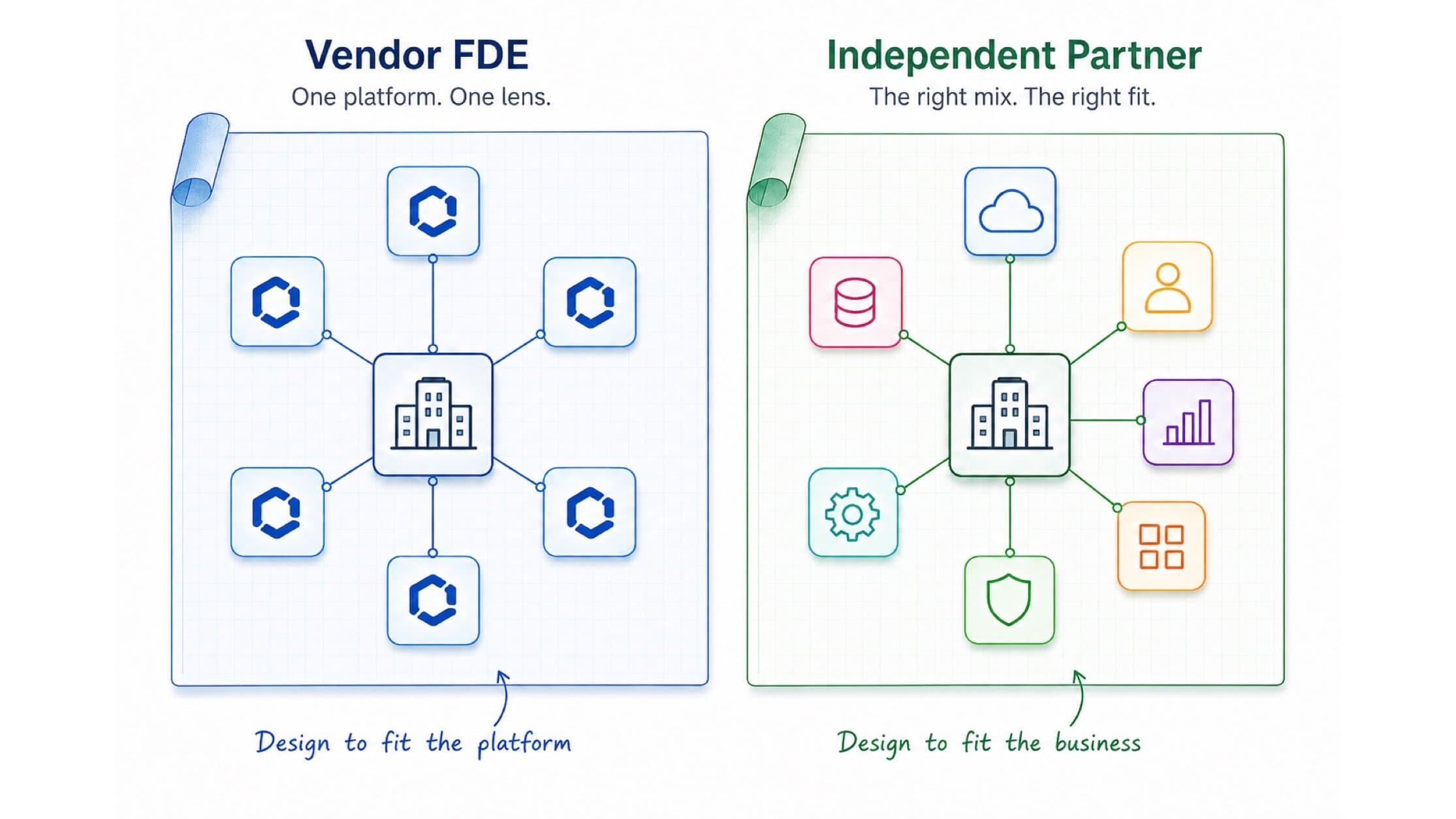
You're Buying a Hammer, but You Need a Blueprint
Another week, another dozen AI tools promising to change everything. The pace is dizzying - but the companies winning with AI didn't start by picking a tool. They started with a plan.


Another week, another dozen AI tools promising to change everything. It's enough to make anyone think, "Maybe I'll just wait a month and see what comes out then."
I get it. The pace is dizzying.
The AI tools ecosystem has become vast and fragmented. Thousands of products exist, many offering overlapping capabilities with different trade-offs. Worldwide AI spending hit an estimated $2 trillion in 2026 - a 44% jump from the year before. The market is flooded with options, and every vendor has a compelling demo.
But putting your AI journey on hold is a gamble. And picking a tool without a strategy is an even bigger one.
Most AI services are designed to do one thing very well. They're like a specialized tool in a toolkit. But they aren't designed to understand and automate your entire business process from end to end. You need a strategy first, then the tools to execute it - not the other way around.
The Hammer Problem
Here's a pattern we see constantly: a business leader attends a conference, sees an impressive AI demo, gets excited, and buys the tool. The marketing team gets a content generator. The sales team gets an outreach assistant. The operations team gets a chatbot. The finance team gets a document summarizer.
Six months later, each department has its own AI tool. None of them talk to each other. None of them connect to the company's core systems. The monthly subscription costs are adding up, and nobody can point to a measurable impact on the business.
This is the hammer problem. When you start with the tool, you end up looking for nails. When you start with the blueprint - a clear understanding of your processes, bottlenecks, and priorities - you choose the right tool for the right job and integrate it where it actually creates value.
The Tool-First Trap
Deloitte's 2025 survey found that the AI skills gap is the biggest barrier to integration - and that education, not tool deployment, was the number one way companies adjusted their talent strategies. The problem isn't access to tools. It's knowing what to do with them.
The Gap Is Widening
While some businesses deliberate, others are already in motion. And the distance between those two groups is growing every quarter.
BCG's 2025 global study of 1,250 executives found the landscape splitting into three distinct tiers. A small group of future-built firms - just 5% of companies studied - are generating substantial value from AI. Another 35% are scaling up and beginning to see returns. The remaining 60% report minimal gains and haven't built the capabilities needed to scale.
The gap between the top and bottom isn't closing. Future-built companies are achieving 1.7x revenue growth and 3.6x shareholder returns compared to laggards. They plan to invest more than twice as much in AI and expect twice the revenue increase from that investment.
This isn't about first-mover advantage in the traditional sense. It's about capability compounding. Every month that a company operates with AI in its core processes, it's learning - refining workflows, training its people, building institutional knowledge about what works. That organizational muscle can't be purchased off the shelf later.
Your competitors who have already started with AI aren't just experimenting. They're integrating AI into their core operations and building a massive head start.
Every day you wait, the gap gets wider. Not because the technology gets harder to access - it doesn't. Because the organizational capability to use it effectively takes time to build, and your competitors are building it right now.
Why Strategy Beats Tools Every Time
MIT's GenAI Divide research reinforced this point with hard data. Despite $35-40 billion in collective enterprise AI investment, 95% of organizations saw no measurable financial return. The 5% that succeeded shared a common approach: they didn't start with the most impressive technology. They started with a clear problem, a focused scope, and a measurable definition of success.
The research found that external partnerships - working with specialized vendors who understand both the technology and the business domain - succeed at roughly twice the rate of internal builds. Not because internal teams lack talent, but because specialized partners have already learned the implementation lessons that every organization otherwise has to discover the hard way.
| Starting Point | Outcome |
|---|---|
| "Let's buy an AI tool" | Tool gets deployed, usage drops within weeks, no measurable impact |
| "Let's automate everything with AI" | Scope creep, budget overruns, pilot purgatory |
| "What's our highest-ROI process to automate?" | Focused deployment, measurable results, foundation for expansion |
The third approach wins consistently. It's less exciting at the outset - there's no dazzling demo to show the board. But it's the approach that produces results that actually matter.
How to Build the Blueprint
So, how do you begin without getting overwhelmed? You start with a plan. Here's the framework we use with every client, and it works regardless of industry, company size, or AI maturity.
Step 1: Map Your Processes
Before touching any AI tool, document your key business processes. Not at a high level - at the level of individual steps, decision points, handoffs, and time costs. Where does work queue up? Where do errors happen? Where are people doing repetitive tasks that follow clear patterns?
This process map is your blueprint. Without it, any AI investment is a guess.
The Process Audit
The most common discovery in our workshops: the biggest opportunities for AI aren't where leaders expect them. Marketing and sales get the attention, but the highest ROI usually lives in operations, finance, and customer service - the processes nobody puts on a slide deck.
Step 2: Score and Prioritize
Not every process is a good candidate for AI. Evaluate each one against a simple framework:
Impact: How much time, cost, or revenue is at stake?
Feasibility: Is the data clean and accessible? Are the rules well-defined?
Risk: What happens if the AI makes a mistake? Can it be caught before it matters?
The sweet spot is high impact, high feasibility, and low risk. That's your first project. Prove value here, and the rest of the organization will follow.
Step 3: Design the Integration
The tool comes last, not first. Once you know which process to automate and what success looks like, you can evaluate tools based on fit - not on how impressive the demo looked.
Key questions at this stage: Does this tool integrate with our existing systems? Can it work inside the workflows our people already use? Can we measure its impact against our defined success criteria? What's the realistic timeline to production?
Step 4: Deploy, Measure, Expand
Start narrow. Measure relentlessly. Expand only when the first use case is proven. This phased approach turns AI from a high-risk liability into a strategic asset that delivers tangible value at every milestone.
The companies capturing real value from AI aren't just automating - they're reshaping and reinventing how their businesses work.
The Blueprint in Practice
We run discovery workshops specifically for this. We sit down with a business, map out their current processes, and identify the key opportunities for AI. The outcome is a practical report - a prioritized roadmap with clear milestones, realistic timelines, and measurable success criteria for each phase.
It's not a 200-page strategy document that sits on a shelf. It's a working blueprint that answers three questions:
Where should we start? The single highest-ROI process to automate first.
What does success look like? Specific, quantifiable metrics tied to business outcomes.
What's the path forward? A phased roadmap where every step is a measurable win that validates the next investment.
This approach turns "we should probably do something with AI" into a concrete plan that your team can execute against and your board can measure.
The Phased Approach
The most successful AI initiatives aren't born from massive, speculative budgets. They come from a controlled process: pinpoint specific opportunities, co-design a phased roadmap with clear milestones, use those milestones to validate the spend, and ensure every step forward is a measurable win. Build momentum, don't bet the farm.
Stop Waiting. Start Planning.
The pace of AI development isn't going to slow down. There will always be another tool, another model, another breakthrough next month. If you wait for things to settle, you'll be waiting forever.
But you don't need to adopt every tool. You don't need to transform every process at once. You need a plan that identifies where AI will create the most value in your specific business, and a disciplined path to get there.
The companies on the right side of this divide didn't have better technology. They had a better blueprint.
A hammer without a blueprint builds nothing useful. A blueprint without a hammer is just a plan. The companies winning with AI have both - and they got the blueprint first.
Feeling overwhelmed by the pace of AI? Let's build your blueprint together. We'll map your processes, identify the highest-value opportunities, and design a practical roadmap that turns AI from a gamble into a strategy.
Find Kipanga useful? Add us as a preferred source and Google will surface more of our work in your results.


25+ years of experience in web development and technology leadership. AWS-certified professional who has led major digital projects for brands like A2 Milk, Toll, and Uniting. Advocates a pragmatic, milestone-driven approach to technology.
View profile
Ready to scale your operations?
Let's discuss how Kipanga can architect the systems that power your next phase of growth.
Start the Discovery